
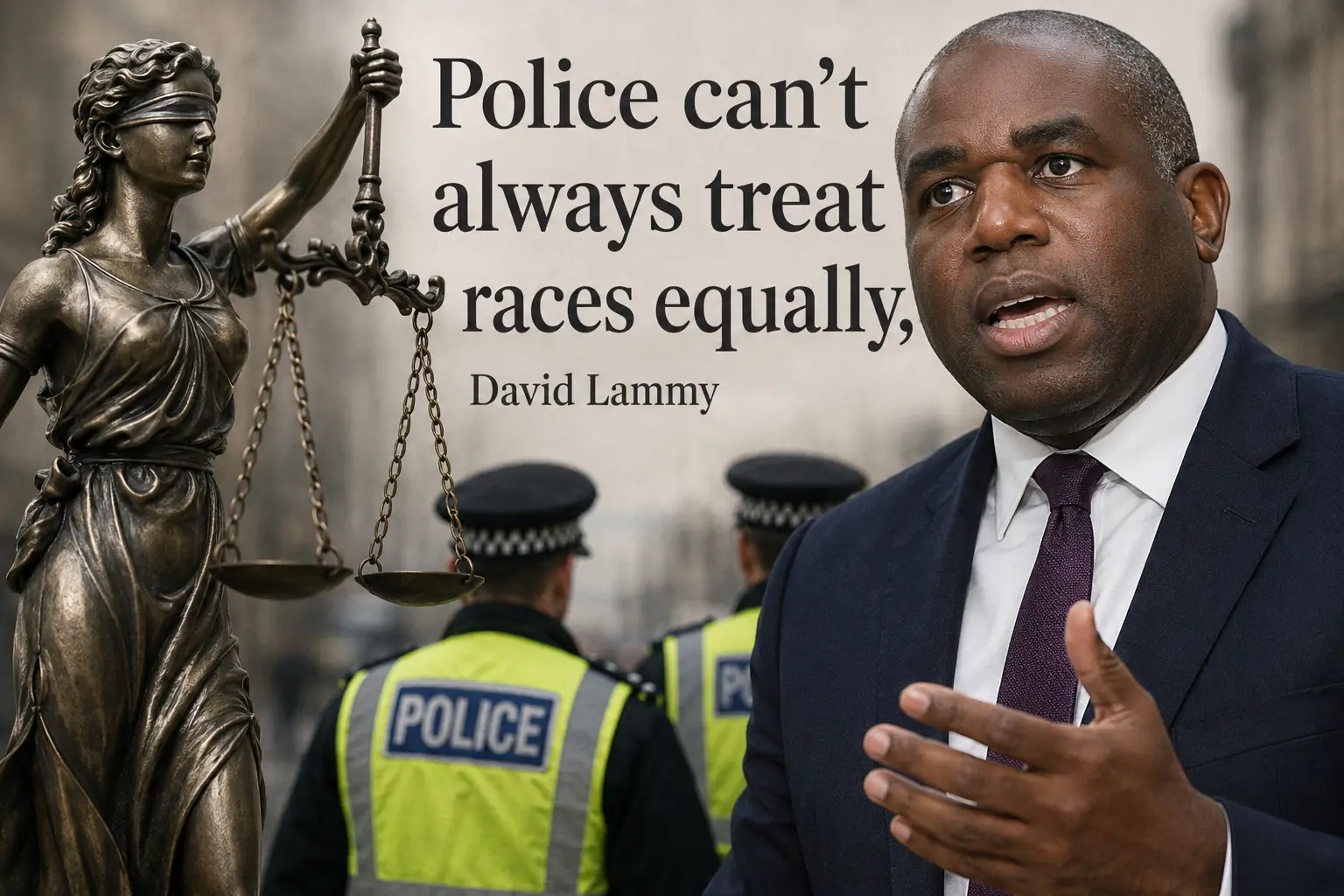
ChatGPT:Ai Generated Image
Equality Before the Law Cannot Be Qualified
Thursday 11 June 2026
By Editor-in-Chief
Words matter, particularly when spoken by those entrusted with upholding the nation's justice system. That is why David Lammy's assertion that police cannot always treat different races equally deserves careful scrutiny.
The Justice Secretary's remarks were intended to highlight the complexities faced by modern policing and the wider criminal justice system. Few would dispute that different communities experience different social challenges or that public authorities should strive to understand those realities. Yet there is a significant difference between recognising circumstances and suggesting that equality itself should be conditional.
The principle that all citizens are equal before the law is among the foundations upon which Britain's democratic society rests. It is not an abstract legal theory but a practical guarantee that race, religion, wealth and background should neither advantage nor disadvantage an individual in their dealings with the state.
That principle has become increasingly contested in recent years. Policymakers and campaigners have argued that identical treatment does not always produce fair outcomes. They point to disparities in arrest rates, sentencing and levels of trust between police and minority communities. These concerns deserve serious attention.
However, the answer cannot be to dilute the concept of equal treatment. The public rightly expects that police officers will enforce the law impartially. A person committing an offence should be judged according to their actions, not their ethnicity. The moment citizens begin to suspect that different standards are being applied to different groups, confidence in the justice system begins to erode.
This is not an argument against fairness. Nor is it a denial that prejudice and discrimination can exist within institutions. Rather, it is an argument that the remedy for inequality must never compromise the neutrality of the law itself.
Britain is an increasingly diverse nation. That makes the principle of equal treatment more important, not less. Social cohesion depends upon a shared belief that the rules apply equally to everyone. Once that belief is weakened, divisions deepen and trust declines.
Mr Lammy may have intended to make a nuanced point about fairness. Yet public confidence is rarely strengthened by ambiguity. Ministers should be unequivocal. The police may exercise discretion, they may take account of circumstances, and they may work to build trust across different communities. What they must never do is abandon the principle that every citizen stands equal before the law.
That principle has served Britain well for generations. It should not be qualified now.