Grok:Ai generated image
The West’s Iran Policy Is Running on Empty — and Denial Is Not a Strategy
Monday 10 June 2026
Editor-in-Chief DJ
There is a growing tendency in Western capitals to treat Iran as a problem that can be managed indefinitely through cautious diplomacy, incremental sanctions, and carefully calibrated “de-escalation.” It is a comforting illusion. It is also increasingly detached from the strategic reality on the ground.
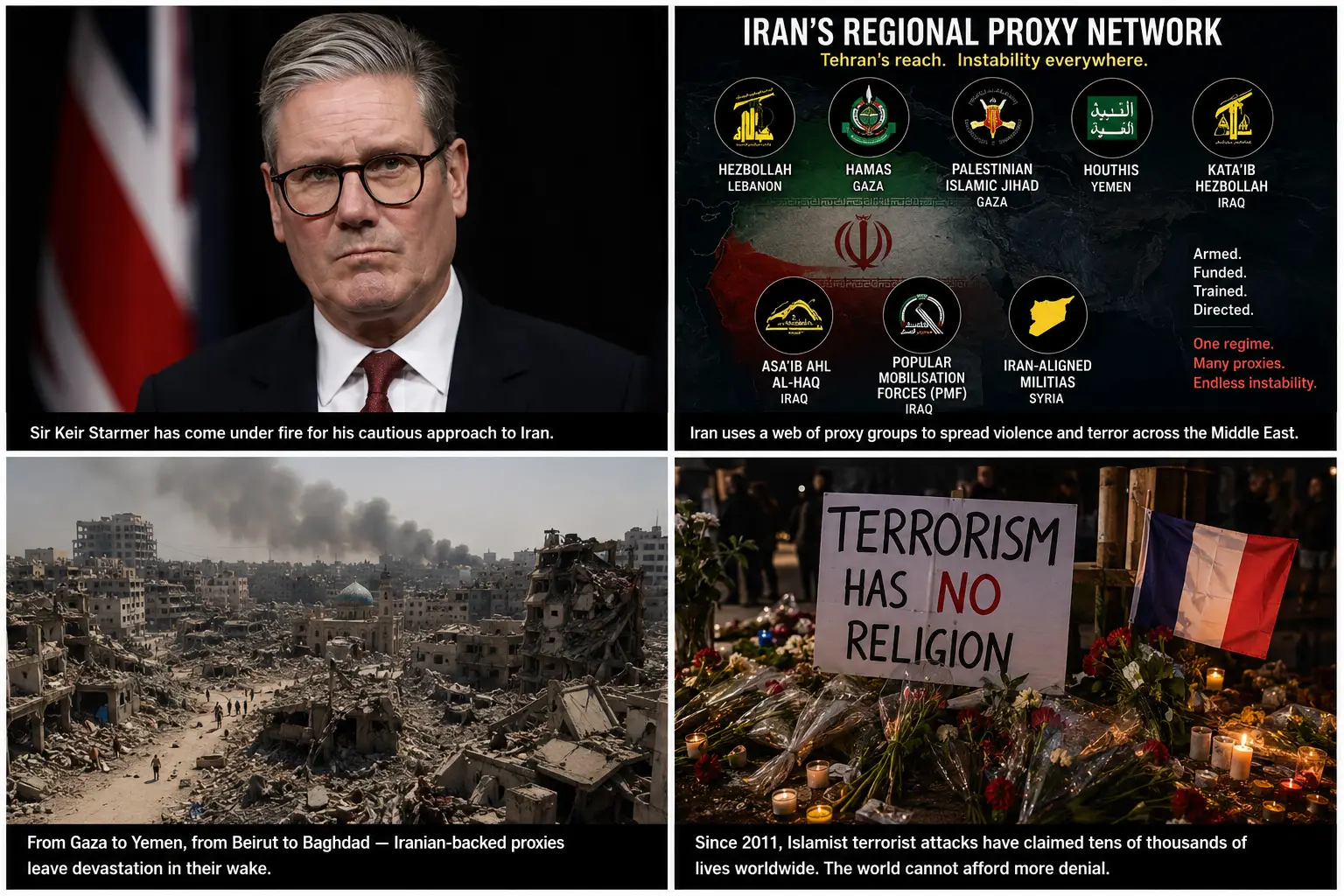
Iran today is not simply a regional state actor. It is the central node of a sprawling network of armed groups across the Middle East—an architecture of influence built deliberately over decades and now embedded in multiple active conflict zones. These include Hezbollah in Lebanon, Hamas and Palestinian Islamic Jihad in Gaza, the Houthi movement in Yemen, and a range of Iraqi militias such as Kata’ib Hezbollah and Asa’ib Ahl al-Haq, alongside elements within Syria’s pro-government militia landscape. These groups do not operate under identical command, but they are widely assessed by Western governments and intelligence agencies to benefit from Iranian funding, training, weapons, and strategic coordination via the Islamic Revolutionary Guard Corps.
To pretend this is incidental influence is to misunderstand the nature of the system entirely.
Containment has become complacency
Successive Western governments—Labour and Conservative alike—have settled into a pattern that prioritises stability management over strategic resolution. The logic is familiar: avoid escalation, maintain diplomatic channels, and rely on sanctions as a pressure valve. Yet after years of this approach, the result is not containment but consolidation. Iran’s regional footprint has not shrunk; it has adapted, dispersed, and in some theatres expanded.
Meanwhile, the cost of inaction is paid in repeated regional wars, disrupted shipping routes, missile exchanges, proxy battles, and the constant risk of escalation between nuclear-armed allies and heavily armed non-state actors. The Middle East has become a permanent theatre of attritional conflict in which Iran-linked networks are one of the central organising forces.
A failure of political honesty
What is missing in Western discourse is not intelligence, but candour. Policymakers are often willing to acknowledge privately what they avoid stating publicly: that the current framework is not working. Yet public-facing policy remains trapped between diplomatic optimism and domestic political caution.
In the United Kingdom, Sir Keir Starmer’s Labour leadership has emphasised restraint, multilateral coordination, and the avoidance of wider military entanglement. Critics argue that this reflects a broader Western reluctance to confront the structural nature of Iran’s regional strategy. Supporters counter that escalation risks far greater instability.
Both positions contain elements of truth—but neither answers the central question: what does “containment” mean when the system being contained is actively adaptive, transnational, and already embedded across multiple war zones?
Grok:Ai generated image
The scale of instability since 2011
Since the collapse of order in parts of the Middle East following 2011, the region has endured successive waves of violence involving state collapse, insurgency, sectarian conflict, and the rise and fall of the Islamic State. The aftermath has not been a return to equilibrium but a fragmentation of authority across multiple competing armed actors.
It is essential, however, to be precise: terrorism and political violence in this period have been driven by a complex mix of ideological extremism, state failure, foreign intervention, and civil war dynamics. Reducing this to a single cause or framing it through a single identity lens is not only analytically weak but politically dangerous.
The strategic dead end
The uncomfortable truth is that Western policy is stuck between two unsatisfactory options: a containment strategy that is increasingly porous, and an escalation strategy that risks widening conflict far beyond any clear endpoint.
Yet avoiding this dilemma does not make it disappear. Iran’s network of aligned armed groups remains a central feature of regional instability, and any serious policy must grapple with that fact rather than reframe it into manageable diplomatic language.
This does not require reckless confrontation. It does require abandoning the fiction that the current approach is sufficient.
Conclusion: time for strategic clarity
The debate in London, Washington and Brussels needs to move beyond slogans and political positioning. Whether one favours diplomacy, deterrence, or a combination of both, the baseline assumption must be realism: Iran’s regional influence network is not a peripheral issue. It is a structural element of Middle Eastern geopolitics.
Until Western governments acknowledge that clearly—and design policy accordingly—crisis management will continue to replace strategy. And the cycle of instability will continue to define the region.